 There is nothing magic in Christianity. There are no short cuts, but everything passes through the humble, patient logic of the grain of wheat which dies to give life, the logic of the faith which moves mountains with the meek strength of God. For this reason God wishes to renew humanity, its history and the universe by means of this chain of transformations of which the Eucharist is the sacrament. By means of the consecrated bread and wine, in which his Body and Blood are truly present, Christ transforms us, assimilating us to himself; he involves us in his work of redemption, making us capable by means of the grace of the Holy Spirit of living according to the same logic which is his, that of gift, like grains of wheat united to Him and in Him. Thus, sown and maturing in the furrows of history are the unity and peace which are the end to which we are directed, according to the plan of God. Without any illusions, without ideological utopias, we pass along the roads of the world, bearing within ourselves the Body of the Lord, as did the Virgin Mary in the mystery of the Visitation. With the humility of recognizing ourselves as simple grains of wheat, we preserve the firm certitude that the love of God, incarnate in Christ, is more powerful than evil, than violence and than death. We know that God has prepared for all people a new heavens and a new earth, in which peace and justice will reign - and in faith we glimpse the new world, which is our real fatherland. This evening too, we are set off on a journey with us there is Jesus in the Eucharist, the Risen One who has said: "I am with you always, even to the end of the world" (Mt 28: 20).
Showing posts with label Benedict XVI. Show all posts
Showing posts with label Benedict XVI. Show all posts
Sunday, June 2, 2013
Benedict XVI on the Eucharist (Corpus Christi Homily 2011)
There is nothing magic in Christianity. There are no short cuts, but everything passes through the humble, patient logic of the grain of wheat which dies to give life, the logic of the faith which moves mountains with the meek strength of God. For this reason God wishes to renew humanity, its history and the universe by means of this chain of transformations of which the Eucharist is the sacrament. By means of the consecrated bread and wine, in which his Body and Blood are truly present, Christ transforms us, assimilating us to himself; he involves us in his work of redemption, making us capable by means of the grace of the Holy Spirit of living according to the same logic which is his, that of gift, like grains of wheat united to Him and in Him. Thus, sown and maturing in the furrows of history are the unity and peace which are the end to which we are directed, according to the plan of God. Without any illusions, without ideological utopias, we pass along the roads of the world, bearing within ourselves the Body of the Lord, as did the Virgin Mary in the mystery of the Visitation. With the humility of recognizing ourselves as simple grains of wheat, we preserve the firm certitude that the love of God, incarnate in Christ, is more powerful than evil, than violence and than death. We know that God has prepared for all people a new heavens and a new earth, in which peace and justice will reign - and in faith we glimpse the new world, which is our real fatherland. This evening too, we are set off on a journey with us there is Jesus in the Eucharist, the Risen One who has said: "I am with you always, even to the end of the world" (Mt 28: 20).
Sunday, April 21, 2013
Benedict and Francis: Compare and Contrast?
 To have a pope and
a pope emeritus for the first time
in, well… centuries, invites particular comparisons between them. There has never been a press environment and
blog environment like what we have today, desperate to ‘scratch the itch’… to
indulge in the irresistible urge to compare and contrast… and even pick a
favorite. This attitude is, of course,
antithetical to who and what we are as Catholics. The pope, whoever he is, is but a man, with
his own gifts and his own limitations.
Modern popes are, by and large, elderly gentlemen who have had extensive
experiences as priests and bishops and leaders in different capacities in the
world-wide Church. In recent decades,
the popes have come from lands far and wide, but still originating in the
relatively homogeneous to a Western-European mold.
To have a pope and
a pope emeritus for the first time
in, well… centuries, invites particular comparisons between them. There has never been a press environment and
blog environment like what we have today, desperate to ‘scratch the itch’… to
indulge in the irresistible urge to compare and contrast… and even pick a
favorite. This attitude is, of course,
antithetical to who and what we are as Catholics. The pope, whoever he is, is but a man, with
his own gifts and his own limitations.
Modern popes are, by and large, elderly gentlemen who have had extensive
experiences as priests and bishops and leaders in different capacities in the
world-wide Church. In recent decades,
the popes have come from lands far and wide, but still originating in the
relatively homogeneous to a Western-European mold.
The press and blog narrative
I am hearing in many places is that Benedict is the old standard-bearer who
enjoyed the trappings of office and was not willing or able to shepherd the
reforms necessary to make the Church more ‘relevant’ to the needs of the modern
world. Francis is being hailed as a ‘breath
of fresh air’, as exemplified by his public acts of charity and humility, along
with the new energy that he is bringing to the office. Anyone who has been paying attention,
however, knows that there is more to this story than the myopic press narrative. These are both unbelievably humble men. These are both men of endless energy and zeal
for the Gospel. These are both men who
are, no doubt, faithful unto death to
the core teachings and beliefs of the Church.
There will be no women priests or wholesale alienation of the patrimony
of the Church under Benedict or Francis or their successors. The pope, no matter who he is, cannot turn the Church into something she is not. Meanwhile, each pope will live the Petrine ministry, day-by-day, each in his own unique way... this is an area where, perhaps, comparison is not only permitted, but fruitful, for each pope will emphasize through their own person and personality (created by God and elected by the Holy Spirit to the Petrine ministry) what it means to live and minster "as Peter" in a particular age. It is yet another sign of the incarnational nature of our Church. God places the grace and power of his divinity in the weak, earthen vessels of humanity, that his glory may be perfected in the world. Ubi Petrus, ibi ecclesia... where there is Peter, there is the Church.
In today’s
meditation in Francis Fernandez’s In
Conversation with God, he cited a writing of Georges Chevrot (1879-1958),
which better articulates what I am trying to communicate:
…we will not fall into
the all too easy temptation of setting one Pope against another, having
confidence only in those whose actions respond to our personal feelings. We are not among those who nostalgically look
back to a former Pope or look forward [to] one in the future who will
eventually dispense us from obeying the present one. Read the liturgical texts for the coronation
of Pontiffs and you will notice that nowhere is there a reference to a
conferral of powers proportionate to the dignity of the person elected by the conclave. Christ gives these powers directly to Peter’s
successor. Therefore in speaking of the
Roman Pontiff we exclude from our vocabulary any expressions derived from the parliamentary
assemblies or the polemics of newspapers; let it not be said that people not of
our faith should be ones who explain the prestige of the head of Christendom in
the world to us.
Wednesday, February 27, 2013
Aaron and Hur... and Benedict
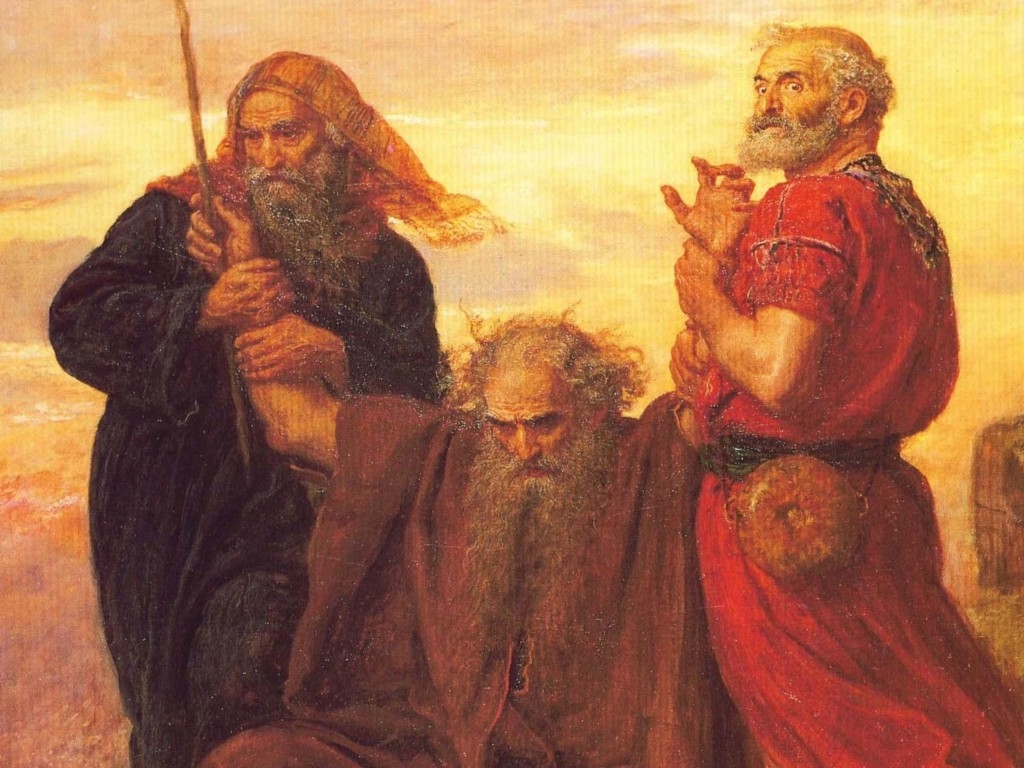 "... As long as Moses kept his hands raised up, Israel had the better of the fight, but when he let his hands rest, Amalek had the better of the fight. Moses' hands, however, grew tired , so they put a rock in place for him to sit on. Meanwhile Aaron and Hur supported his hands, one on one side and one on the other, so that the hands remained steady till sunset. And Joshua mowed down Amalek and his people with the edge of the sword." Exodus 17:11-13
The image presented in this morning's Office of Readings, I think, is a timeless icon for ministry in the Church, and a wonderful image to consider as we look into the upcoming Sede Vacante of the Holy See. As a priest and pastor, it is the people who stand with you, holding your arms up in those moments of fatigue, doubt, and trial that help you remember not only the limitations of your own strength, but the providence of God to provide. All the more, how our bishops and our pope needs people standing with him, holding his arms to provide the strength to bear their offices well.
 Pope Benedict has rececived this spiritual support from the entire Church, and he has needed it. Every time we celebrate Mass, he is mentioned during the Eucharistic Prayer... both as a reminder to pray for him, but even more importantly as a reminder of the unity of the Church we express in and with him before Christ. Now as he steps back from the papal office, he sees his role as one standing, holidng up the arms of his successor... I presume that popes do intercede for their successors before the throne of God as they go on to their eternal reward, but Benedict's work is being done with not only incredible humility (recognizing he doesn't have the physical ability to hold the office any more), but with increidble spiritual intimacy... anyone who believes that, in this world, they have the ability to do the spiritual labor of supporting the Church and the one who will be the new pope, while still in this clumsy, limited human condition we all experience, has to be a true prayer warrior. As I said in a previous post, for Benedict to accept this role for the Church places a spotlight on the thousands of religious and faithful everywhere who spend their days hidden in deep, profound, effective prayer for the holiness and deliverance of the Church.
Tuesday, February 26, 2013
Pope Benedict XVI on the "True Council" and the Media
 Just over a week ago, the pope gave a final talk to the priests and seminarians of the Diocese of Rome, where he gave what many are calling his "final master class". As a paretus of the Council, a bishop, cardinal, and pope, he has a perspective on the Church over the last fifty years which has a lot to tell us about how we have managed to enter into conversation with the "modern world", where we still need work, and where the "modern world" has drawn a line in the sand, that we are not supposed to not cross, except at our peril.
As I have been recently reflecting on the role of the media in our contemporary (notice, I don't say 'modern',) society, there's a lot of truth here. The council and the Church at large is in search of the truth (fides quarens intellectum), plodding and erring as it does, but through the sure guidance of the Holy Spirit in every age, no less our own. The pope understands the "council of the media" to have a much different agenda and end, not the City of God, but the City of Man... the hermeneutic of politics rather than the hermeneutic of faith.
Benedict offers a very instructive contrast to make his point: the teaching of the "true" Council vs. the teaching of the media with regards to his most beloved subject: the liturgy. My highlights below are in bold:
I would now like to add yet a third point: there was the Council of the Fathers - the true Council - but there was also the Council of the media. It was almost a Council in and of itself, and the world perceived the Council through them, through the media. So the immediately efficiently Council that got thorough to the people, was that of the media, not that of the Fathers. And while the Council of the Fathers evolved within the faith, it was a Council of the faith that sought the intellectus, that sought to understand and try to understand the signs of God at that moment, that tried to meet the challenge of God in this time to find the words for today and tomorrow. So while the whole council - as I said - moved within the faith, as fides quaerens intellectum, the Council of journalists did not, naturally, take place within the world of faith but within the categories of the media of today, that is outside of the faith, with different hermeneutics. It was a hermeneutic of politics. The media saw the Council as a political struggle, a struggle for power between different currents within the Church. It was obvious that the media would take the side of whatever faction best suited their world. There were those who sought a decentralization of the Church, power for the bishops and then, through the Word for the "people of God", the power of the people, the laity. There was this triple issue: the power of the Pope, then transferred to the power of the bishops and then the power of all ... popular sovereignty. Naturally they saw this as the part to be approved, to promulgate, to help. This was the case for the liturgy: there was no interest in the liturgy as an act of faith, but as a something to be made understandable, similar to a community activity, something profane. And we know that there was a trend, which was also historically based, that said: "Sacredness is a pagan thing, possibly even from the Old Testament. In the New Testament the only important thing is that Christ died outside: that is, outside the gates, that is, in the secular world". Sacredness ended up as profanity even in worship: worship is not worship but an act that brings people together, communal participation and thus participation as activity. And these translations, trivializing the idea of the Council, were virulent in the practice of implementing the liturgical reform, born in a vision of the Council outside of its own key vision of faith. And it was so, also in the matter of Scripture: Scripture is a book, historical, to treat historically and nothing else, and so on.
And we know that this Council of the media was accessible to all. So, dominant, more efficient, this Council created many calamities, so many problems, so much misery, in reality: seminaries closed, convents closed, liturgy trivialized ... and the true Council has struggled to materialize, to be realized: the virtual Council was stronger than the real Council. But the real strength of the Council was present and slowly it has emerged and is becoming the real power which is also true reform, true renewal of the Church. It seems to me that 50 years after the Council, we see how this Virtual Council is breaking down, getting lost and the true Council is emerging with all its spiritual strength. And it is our task, in this Year of Faith, starting from this Year of Faith, to work so that the true Council with the power of the Holy Spirit is realized and Church is really renewed. We hope that the Lord will help us. I, retired in prayer, will always be with you, and together we will move ahead with the Lord in certainty. The Lord is victorious. Thank you.
The instructive point here is that we are all conditioned by the lenses we use to see the world, but those lenses themselves are not truth. Truth is perceived and identified and loved by people of faith who rightly interpret the messages and the signs and the challenges of the times. Those who can only see the Church as a mere social structure, where power is distributed and exercised, where order and coercion is maintained, where human beings control their own identity and destiny... they will always be disappointed as they see the Church in her authenticity and in her reality stand up and breathe fresh air upon the world through its teaching and its understanding of the human person in relationship to God. One only has to look at the angst spent against the Church in the recent debates against same-sex 'marriage' and the decades-old battle against abortion. These debates tend not to be a battle from enlightened ideas from "the world", so much an array of ideologies calling into question the legitimacy of the Church to even enter into the conversation. Read the comments on your local newspaper's blog whenever an article about the Church appears if you want to understand what I mean. This battle is personal, but we cannot back down from that battle.
To apply a political lens to the Church, and to see the Church exclusively as a social reality results so readily in the misery, not only of closed seminaries and convents and weak liturgy as the pope points out, but may I add, the misery of poor Mass attendance (both in numbers and in fervor of those who are there), failing Catholic schools, a demoralized clergy, diminished human and financial resources, and a scattered (and scattering) laity. Benedict is getting at, most pressingly, the way a media hermeneutic has depleted the "imagination" of the faithful such that we don't even understand our own signs and symbols, prayers and practices... we have allowed ourselves to become unmoored in the muddy waters of contemporary, worldly concerns. I would dare say that reacquisition of this "spiritual imagination" is the great gift and the integrating force of the Council, in which Benedict finds and offers hope for the future.
This is not to say that the political lens of the media is an invalid way to look at the Church in the contemporary world, but it cannot be the only way or even the main way if we are to be people of faith. Faith does not cover up the wounds and scars of past failures, but it can offer redemption to these wounds if allowed to permeate them. Faith is not an easy answer... it is, in reality, the hardest answer to underlying the question of the Church and its relationship to secular society. Faith engages all the reason the human person can generate, all the hope the human person can endure, and all the life and vitality the human person can offer. "Take up your cross and follow me" is not a game for wimps. It is not a bargain for those who think they can hold something back for themselves, just in case. It requires all that we are and all that we can offer.
Without faith, there is no way that we can see the Church except in the most pathetic, dimmest light. I think Paul said something that pulls at least tangentially here: "If only for this life we have hoped in Christ, we are the most pitiable people of all." (1 Cor 15:19) As the machinery gears up for the conclave and the seasonal press coverage of the Church, remember the reference point of the media and the need for the gift of great faith to interpret the events correctly and fully. A week after the press circus leaves Vatican Square and the new pope gets on with the business of being the spiritual father of more than 1 billion Catholics, it will be the faith of the people that sustains him and the Church. The faith which will propel us to whatever the Spirit has in store for us next.
To apply a political lens to the Church, and to see the Church exclusively as a social reality results so readily in the misery, not only of closed seminaries and convents and weak liturgy as the pope points out, but may I add, the misery of poor Mass attendance (both in numbers and in fervor of those who are there), failing Catholic schools, a demoralized clergy, diminished human and financial resources, and a scattered (and scattering) laity. Benedict is getting at, most pressingly, the way a media hermeneutic has depleted the "imagination" of the faithful such that we don't even understand our own signs and symbols, prayers and practices... we have allowed ourselves to become unmoored in the muddy waters of contemporary, worldly concerns. I would dare say that reacquisition of this "spiritual imagination" is the great gift and the integrating force of the Council, in which Benedict finds and offers hope for the future.
This is not to say that the political lens of the media is an invalid way to look at the Church in the contemporary world, but it cannot be the only way or even the main way if we are to be people of faith. Faith does not cover up the wounds and scars of past failures, but it can offer redemption to these wounds if allowed to permeate them. Faith is not an easy answer... it is, in reality, the hardest answer to underlying the question of the Church and its relationship to secular society. Faith engages all the reason the human person can generate, all the hope the human person can endure, and all the life and vitality the human person can offer. "Take up your cross and follow me" is not a game for wimps. It is not a bargain for those who think they can hold something back for themselves, just in case. It requires all that we are and all that we can offer.
Without faith, there is no way that we can see the Church except in the most pathetic, dimmest light. I think Paul said something that pulls at least tangentially here: "If only for this life we have hoped in Christ, we are the most pitiable people of all." (1 Cor 15:19) As the machinery gears up for the conclave and the seasonal press coverage of the Church, remember the reference point of the media and the need for the gift of great faith to interpret the events correctly and fully. A week after the press circus leaves Vatican Square and the new pope gets on with the business of being the spiritual father of more than 1 billion Catholics, it will be the faith of the people that sustains him and the Church. The faith which will propel us to whatever the Spirit has in store for us next.
--Fr. Tom Donovan
Friday, February 15, 2013
Twelfth Station: Cardinal Ratzinger (2005)

Via Crucis, Scuola Veneta - Sec. XVIII
Cattedrale - Padova
TWELFTH STATION
Jesus dies on the Cross
Jesus dies on the Cross
V/. Adoramus te, Christe, et benedicimus tibi.
R/. Quia per sanctam crucem
tuam redemisti mundum.
From the Gospel according to John 19:19-20
Pilate also wrote a title and put it on the Cross; it read,
“Jesus of Nazareth, the King of the Jews”. Many of the Jews read this title, for
the place where Jesus was crucified was near the city; and it was written in
Hebrew, in Latin, and in Greek.
From the Gospel according to Matthew 27:45-50,54
Now from the sixth hour there was darkness over all the land
until the ninth hour. And about the ninth hour Jesus cried with a loud voice,
“Eli, Eli, lama sabachthani?” That is, “My God, my God, why have you forsaken
me?” And some of the bystanders hearing it said, “This man is calling Elijah”.
And one of them at once ran and took a sponge, filled it with vinegar, and put
it on a reed, and gave it to him to drink. But the others said, “Wait, let us
see whether Elijah will come to save him”. And Jesus cried again with a loud
voice and yielded up his spirit”. When the centurion and those who were with
him, keeping watch over Jesus, saw the earthquake and what took place, they were
filled with awe, and said, “Truly this was the Son of God!”
MEDITATION: In Greek and Latin, the two international languages of the time,
and in Hebrew, the language of the Chosen People, a sign stood above the Cross
of Jesus, indicating who he was: the King of the Jews, the promised Son of
David. Pilate, the unjust judge, became a prophet despite himself. The kingship
of Jesus was proclaimed before all the world. Jesus himself had not accepted the
title “Messiah”, because it would have suggested a mistaken, human idea of power
and deliverance. Yet now the title can remain publicly displayed above the
Crucified Christ. He is indeed the king of the world. Now he is truly “lifted
up”. In sinking to the depths he rose to the heights. Now he has radically
fulfilled the commandment of love, he has completed the offering of himself, and
in this way he is now the revelation of the true God, the God who is love. Now we know who God is. Now we know what true kingship is.
Jesus prays Psalm 22, which begins with the words: “My God, my God, why have you
forsaken me?” (Ps 22:2). He takes to himself the whole suffering people
of Israel, all of suffering humanity, the drama of God’s darkness, and he makes
God present in the very place where he seems definitively vanquished and absent.
The Cross of Jesus is a cosmic event. The world is darkened, when the Son of God
is given up to death. The earth trembles. And on the Cross, the Church of the
Gentiles is born. The Roman centurion understands this, and acknowledges Jesus
as the Son of God. From the Cross he triumphs – ever anew.
PRAYER: Lord Jesus Christ, at the hour of your death the sun was darkened.
Ever anew you are being nailed to the Cross. At this present hour of history we
are living in God’s darkness. Through your great sufferings and the wickedness
of men, the face of God, your face, seems obscured, unrecognizable. And yet, on
the Cross, you have revealed yourself. Precisely by being the one who suffers
and loves, you are exalted. From the Cross on high you have triumphed. Help us
to recognize your face at this hour of darkness and tribulation. Help us to
believe in you and to follow you in our hour of darkness and need. Show yourself
once more to the world at this hour. Reveal to us your salvation.
Monday, February 11, 2013
A tale of two popes…
 As I read Facebook this morning, like many of my priest-friends,
I was struck speechless upon hearing about the upcoming ‘resignation’ of
Benedict XVI, Joseph Ratzinger, from the Petrine ministry. Commentators in the media were not struck nearly as
speechless, of course, so a lot has already been said and there will be a lot
more to be said in the days ahead by those who are wiser and more articulate
than I am. The initial thoughts I have
is that, “this is fitting”- a very
“fitting” thing that this gentleman, this priest, this chosen one to carry the
mantle of Peter should choose to do this now.
As I read Facebook this morning, like many of my priest-friends,
I was struck speechless upon hearing about the upcoming ‘resignation’ of
Benedict XVI, Joseph Ratzinger, from the Petrine ministry. Commentators in the media were not struck nearly as
speechless, of course, so a lot has already been said and there will be a lot
more to be said in the days ahead by those who are wiser and more articulate
than I am. The initial thoughts I have
is that, “this is fitting”- a very
“fitting” thing that this gentleman, this priest, this chosen one to carry the
mantle of Peter should choose to do this now.
I don’t say it is “fitting” as a matter of justice… only the
pope can make this decision, and he will stand before God to account of it without
owing me any explanation at all. It is
not in any way appropriate for me to judge or say that we need a younger pope
or a healthier pope or a pope of a different political persuasion... that's God's decision. When I say this decision is “fitting” it doesn't mean either of these things.
His decision is also not “fitting”
in terms of giving this man a well-deserved retirement, even after decades of
priestly and episcopal ministry, and 8 long, difficult years of Petrine
ministry. There is something to the statement that the one who is pope "does not come down from the cross" as Cardinal Dziwisz was reported to have said, but with all due respect to the Cardinal, what was "fitting" for John Paul II is not necessary as "fitting" for Benedict XVI.
I say Benedict's abdication (and I hate that word with respect to what he is doing) it is “fitting” as one
would perceive the ‘fitting’ closure of a good story, where everyone will ‘live
happily after’. It is ‘fitting’ as a
righteous conclusion to completing an arduous task. It is ‘fitting’, as Benedict himself has
concluded in prayer, that this is what the Church in this day and age needs.
But God in his mercy has a way of leading us to those events
in our lives that are most fitting to his glory, doesn’t he?
 Pope John Paul II came to the See of Peter a vigorous man…
fifty-eight, if I recall correctly. I
was in first grade and saw him come out onto the loggia on a black and white TV
with lousy reception… it was right around lunchtime, and my teacher, Sr.
Victorine, was making a very big deal over it, and over receiving the papal
blessing which would end the appearance.
Pope John Paul served for more than 26 years as our supreme pontiff, the
last 10 of which were rather painful for us all to watch, although we all knew
it was ‘fitting’ for him to suffer as he did.
You see, Pope John Paul II deeply understood the importance of his
“Witness to Hope”… a man broken physically by infirmity, this giant of outdoors
and globetrotting needed to show the Church that the pope is not simply a tower
of power, but is ultimately a man of prayer and suffering… one who bears the
wounds of Christ in his own body and in his own life. As a younger man, he courageously engaged and
defeated the greatest political evils of our epoch manifested by the Nazi and
communist regimes. He appeared on the
Loggia that dark night with the message “be not afraid”. He took a would-be assassin’s bullet. He shepherded the Church in the confusion of
the years following the great council.
Pope John Paul II came to the See of Peter a vigorous man…
fifty-eight, if I recall correctly. I
was in first grade and saw him come out onto the loggia on a black and white TV
with lousy reception… it was right around lunchtime, and my teacher, Sr.
Victorine, was making a very big deal over it, and over receiving the papal
blessing which would end the appearance.
Pope John Paul served for more than 26 years as our supreme pontiff, the
last 10 of which were rather painful for us all to watch, although we all knew
it was ‘fitting’ for him to suffer as he did.
You see, Pope John Paul II deeply understood the importance of his
“Witness to Hope”… a man broken physically by infirmity, this giant of outdoors
and globetrotting needed to show the Church that the pope is not simply a tower
of power, but is ultimately a man of prayer and suffering… one who bears the
wounds of Christ in his own body and in his own life. As a younger man, he courageously engaged and
defeated the greatest political evils of our epoch manifested by the Nazi and
communist regimes. He appeared on the
Loggia that dark night with the message “be not afraid”. He took a would-be assassin’s bullet. He shepherded the Church in the confusion of
the years following the great council. In time, his body betrayed him under the assault of
Parkinson’s Disease, until he appeared a mere shell of his former
self. For all the spiritual and temporal
power he wielded as pope, he knew that “power is made perfect in
suffering”. Precisely because we watched him over the years offer himself ever more fully and perfectly into the ministry of suffering, it was fitting that we walk with him all the way out to the end. The world needed to see that this
vigorous missionary of God’s love was first and foremost a man of prayer and
intimacy with God, rather than simply a charismatic personality on the world stage… this core ministry defined him more than any pastoral
trip or encyclical or public ceremony. In
his intimacy with the Cross of Christ, he showed us the greatest dignity of the
human person. Placing himself in the
hands of the crucified Christ, he changed the world if you remember those intensely
spiritual days of Easter 2005. (Remember also the terrible, parallel death of Terri Schiavo also taking place at that time?)
In time, his body betrayed him under the assault of
Parkinson’s Disease, until he appeared a mere shell of his former
self. For all the spiritual and temporal
power he wielded as pope, he knew that “power is made perfect in
suffering”. Precisely because we watched him over the years offer himself ever more fully and perfectly into the ministry of suffering, it was fitting that we walk with him all the way out to the end. The world needed to see that this
vigorous missionary of God’s love was first and foremost a man of prayer and
intimacy with God, rather than simply a charismatic personality on the world stage… this core ministry defined him more than any pastoral
trip or encyclical or public ceremony. In
his intimacy with the Cross of Christ, he showed us the greatest dignity of the
human person. Placing himself in the
hands of the crucified Christ, he changed the world if you remember those intensely
spiritual days of Easter 2005. (Remember also the terrible, parallel death of Terri Schiavo also taking place at that time?) A few weeks after JP2’s departure ‘to the house of his
father’, Benedict came to the loggia in the middle of the day. I was a deacon, finishing my last few weeks
at Mundelein seminary. The smoke was
black and then turned white as I watched with several of my buddies on CNN. (I preferred CNN because they tended to be
quiet and let the news unfold, rather than dealing with the incessant yapping on other networks, but I digress.) Mass at the
seminary was to begin at 11:30, but I and my buddies hung back in the
excitement of the moment (and we went to Marytown at noon… just don’t anyone
tell my formation contact person about this!) and saw Joseph Ratzinger in the
unfamiliar white and red that not only did not seem to belong to him, but had
belonged to another-John Paul II-almost as long as I can remember. There was a buzz around the house as Peter
had been revealed anew in this theologian and vaticanista whom we all knew in
one way or another from our studies. (Yes,
I still have my vintage 2003 “Cardinal Ratzinger Fan Club” mug on my desk at the
parish.) He was the favorite going into
the conclave by many, but as Cardinal George would later explain, when the
cardinals sat down and looked around the room, it was obvious who the right
choice was… it was ‘fitting’, that this leader and closest collaborator with
the old pope sit on the Throne of Peter himself and bring order to a Church
which was feeling lost and abandoned by the death of its beloved father.
A few weeks after JP2’s departure ‘to the house of his
father’, Benedict came to the loggia in the middle of the day. I was a deacon, finishing my last few weeks
at Mundelein seminary. The smoke was
black and then turned white as I watched with several of my buddies on CNN. (I preferred CNN because they tended to be
quiet and let the news unfold, rather than dealing with the incessant yapping on other networks, but I digress.) Mass at the
seminary was to begin at 11:30, but I and my buddies hung back in the
excitement of the moment (and we went to Marytown at noon… just don’t anyone
tell my formation contact person about this!) and saw Joseph Ratzinger in the
unfamiliar white and red that not only did not seem to belong to him, but had
belonged to another-John Paul II-almost as long as I can remember. There was a buzz around the house as Peter
had been revealed anew in this theologian and vaticanista whom we all knew in
one way or another from our studies. (Yes,
I still have my vintage 2003 “Cardinal Ratzinger Fan Club” mug on my desk at the
parish.) He was the favorite going into
the conclave by many, but as Cardinal George would later explain, when the
cardinals sat down and looked around the room, it was obvious who the right
choice was… it was ‘fitting’, that this leader and closest collaborator with
the old pope sit on the Throne of Peter himself and bring order to a Church
which was feeling lost and abandoned by the death of its beloved father.
Even though past the age of 75, he took on the Office of
Peter with profound humility and faith—something which I don’t think is
understandable by so many who see the papacy as a mere expression of temporal
power and influence over the political and social machinery of our Church. I could see it in his eyes that very first
day though, that understanding who he was to be as a ‘worker in the vineyard’
and the poor soul chosen to stand in the very big shoes of the fisherman before
him. He would be different; he would be
approaching the ministry not in vigor of a young JP2, but in a careful,
sustained way to preserve his ability to carry out the apostolic work as long
as possible with his own sense of integrity and zeal. Our expectations were different, our needs as a Church were different. It would be only natural to see his papal
persona in terms of the sustained theological reflection offered in his books,
and the sobriety with which he celebrated the sacred rites, compared to his fiery
predecessor in his prime.

And so we come to this day when Benedict formally announces
his intention to lay down his Petrine ministry.
How is it ‘fitting’? He says that
a healthier, more vigorous man needs to step in, and he will go off to live his
remaining days in intense prayer for the Church. Like JP2, Benedict XVI is a man of profound prayer and
divine intimacy. One thing I see is that his announcement highlights
and validates anew the fundamental work of so many religious and other faithful
around the world who spend their lives in prayer outside of the eye
of cameras and away from the microphones... some in cloisters, some in nursing homes (some as ministers and some as residents), some in quiet, seemingly-insignificant and forgotten ministries across the far-flung world.
A pope lives not only to rule and guide the Church, but to pray for
it. JP2 understood this and a great part of his witness to prayer was open, public suffering. But Benedict XVI understands that God has not chosen
to give him the same vocation of suffering, but rather the special
gift of insight that he can legitimately lay down the yoke of ministry in the humility to allow
another to take it up. In doing this Benedict finds that he can maintain his personal integrity as Joseph Ratzinger, now to be bishop-emeritus of Rome and prayer-warrior for the Church. In discerning this radical change in course, he is now being welcomed
by God to do something new but no less important in his twilight years. The Church needs his offering of praise and further, God will use his servant to highlight and
raise the dignity of contemplative prayer as a vocation before the world while another Peter takes on the bold ministry of building up the brethren through active governance and pastoral care of the Church. If this is what Benedict has heard with 'certainty' from God, how can we say anything but, 'how fitting'!
I am confident that God will provide a successor to Benedict
who will fulfill the needs of the Church going forward. I don’t know if it is a globetrotter or a
non-Italian ‘third-world’ pope, a liberal or conservative, old or young… I just
know that in the last century-and-then-some, we have been tremendously blessed
by the men who have heard the call to ‘put out into the deep’ as Peter did, and
have taken that call with intense faith and dedication. I trust that the Spirit is alive, well, and
active in this ministry, and in doing so, I recognize that, while surprising,
today’s announcement is eminently ‘fitting’.
--Fr. Tom Donovan
Subscribe to:
Posts (Atom)