Showing posts with label Lent. Show all posts

Friday, April 18, 2014

Stabat Mater: Gregorian Melody

The Stabat mater, which we have been listening to throughout Lent on Fridays, finds its origin as a Sequence for Mass on September 15, the feast of the Holy Cross and is used today as a Sequence for the Feast of Our Mother of Sorrows, September 16.  As I have explained before, sequences are an insertion of the Middle Ages into the Order of Mass which had a strongly devotional and didactic flavor, which used the language of doctrine and theology (rather than scripture, strictly speaking) to communicate the faith.  By the time of the Council of Trent, hundreds of them littered the liturgy, perhaps something akin to singing a sacred (but not strictly scriptural song) from our various hymnals each week before the Gospel.  In the reforms of the Council of Trent, this pious custom was jettisoned from almost all Masses, save a small few.  Even fewer remain today following the reforms of the Second Vatican Council.
   The liturgical sequence invites us, through song and music, to consider and meditate on the greatest mysteries of our faith.  Consider the fiery Dies Irae warning sinners of the coming of God to judge the living and the dead.  Consider the elation of the Victimae Paschales Laudes proclaiming Jesus raised from the dead.  Consider the breath of the Spirit breathed on the disciples in phrases and poetry of the Veni Creator Spiritus.  In these last seven weeks, the intent of these articles were to highlight artistic attempts to capture the pathos of the Blessed Mother's own suffering at the foot of the cross, as a model and inspiration us today.  Are we strengthened by the Mother's witness?  Are we sorrowful for the sins that lead to such a great sacrifice?  Can we stand faithfully by the cross and witness the glory of the Lord revealed for all time?  That's the invitation of the Stabat mater and the series that completes today.
   And so today, to finish up, the unvarnished, unaccompanied chant that dates to the medieval Church:


Sunday, March 23, 2014

Homily Notes: Third Sunday in Lent (Year A)

   The Western Church presents a triptych of readings on Sundays 3, 4, and 5 of the "Year A" cycle of Lenten readings in the ordinary form--readings that are so iconic to the spirit of Lent and the regeneration of souls, that the Rite of Christian Initiation of Adults (RCIA) prescribes them to be read every year (in years "B" and "C" as well) when catechumens are present and the pre-baptismal exorcisms ("scrutinies") are pronounced over them.  Along with this week's reading of the "Woman at the Well", next week we will hear about the "Man Born Blind", and the week after, the "Raising of Lazarus".  From these three readings, the Lord is seen as one who has the power to turn the barren soul fruitful in right worship, to give enlightenment to the blind, and finally, to raise the dead to life.  All of these mighty works are achieved in their recipients by the acceptance of our Lord in faith as the Messiah.
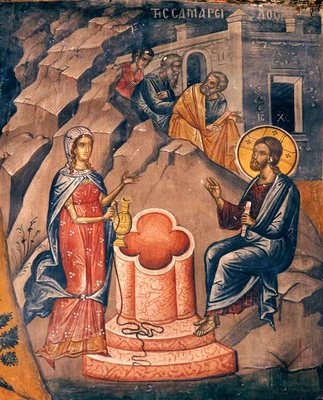
   Parenthetically, in the Orthodox Church this reading is part of the Easter ("Pascha") cycle, and the woman at the well is given a name, St. Photini (the 'enlightened one').  She was considered "equal" to the apostles, as the first to be commissioned to take the Good News of our Lord to the citizens of Samaria.  While chronologically before the passion, death, and resurrection of the Lord in the Gospel of John, the importance of this reading, highlighting the clemency of our Lord in the conversion and regeneration of sinners by his saving work is clear.

   The reading begins by explaining that Jesus had been in conflict with the Pharisees.  In chapter 3 of John's Gospel, Jesus revealed himself to the Jewish leader Nicodemus as nothing less than the 'Son of God' through whom one must be 'born again' to have eternal life.  Nicodemus continued to respond to the Lord in questioning ambivalence to his revelation, apparently preferring to remain in the dark, than to accept the transformative Love of God, which came, not to condemn the world, but that the world might be saved through faith in him (cf John 3:16ff).  Thus, as Jesus was traveling down from Galilee to Jerusalem, (which would have necessitated his transit through the unfriendly region of Samaria and the town of Sychar,) he would not only be exhausted by the journey through the desert itself, but he would likely be suffering a certain kind of spiritual exhaustion, having failed up to that point to have gained the faith of the people and failed (so far) in fulfilling his mission of drawing all men and women into the love of God the Father.  Indeed, Jesus no doubt could see that the world was full of unenlightened sinners, lost in the shadows of death, and unresponsive to the invitation of partaking in the joy of the 'Father's House'.  His work would be cut out for him, if he was to reveal the love of the Father to all the world, if his own people would completely reject him--and not with scorn and persecution at this point, but through what I would argue to be the much more painful attitudes of indifference and ambivalence.
   And so, Jesus approaches the well in Sychar at the sixth hour--about noon--and finds a woman present.  He asks for some water.  Immediately. we recognize that the request is wrapped in a kind of triple symbolism.  First: water is praised throughout scripture as the source of fruitfulness in the desert.  Our first reading from Exodus 17 speaks to this.  We hear in a number of important places in Isaiah (such as chapter 35 and 44) that the desert (as an icon of the parched soul) will be made fruitful by the gift of water.  We hear the prophecy (Ezekiel 47) that water will flow from the temple, growing into an ever-greater stream nourishing all the nations.  The psalms are replete with further examples.  None other than Jesus himself had been discussing the importance of water as the means of rebirth and regeneration... Nicodemus was told that he must be reborn of water and the spirit (John 3: 5), a water that unmistakeably needs to be associated with the Sign of Cana (in John 2) where water was the precursor to a renewed celebration of the coming of the Kingdom of God in Jesus.
  Secondly, we see a more subtle symbolism in the interaction of these two at the well.  A man approaching a woman at a public well would have the biblical connotation of 'flirting' between the man and woman.  Indeed, this would be confirmed by the progression of the conversation into the revelation of the marital status of the woman--married five times previously, and unsuccessfully joined at the moment.  But this 'flirtation' is not rooted in mere physical attraction, but rather in divine love God has for his people.  Make no mistake, Jesus is indeed 'wooing' this woman's affections, but in a way to satisfy her need that the world cannot give.  Again, this interpretation flows from the Wedding at Cana two chapters before, where the Lord endorses marriage as a sign of the Kingdom.  Flowing from the wedding bond is the new fruitfulness of the husband and wife where, according to the near-Eastern understanding of the day, the husband makes the wife fruitful in the marital bond, and the wife in turn bears children as gift to her husband.  The fruitfulness of the waters and rains in the desert had the same effect-- as the waters make the earth fruitful, so to is humanity refreshed, returning glory to God, the Father of the rains.
   Finally, the reading tells us that the encounter between Jesus and the woman takes place at the height of day... at the height of enlightenment, where nothing is hidden and all is to be revealed.  No doubt neighbors saw the encounter and a discussion of the event would be 'news' (gossip) about the community.  This foreign 'prophet' spoke (flirted) with a woman whose shame was precisely that she was not in a faithful, fruitful spousal relationship.  Exposed at that noonday hour to the criticism and judgment of her neighbors, she found new strength and hope through the loving gaze of the Savior.  She would not be defined by her past infidelities, but rather by a new beginning in faithful (apostolic) fruitfulness.
Samaritan Idols
   And so, the discussion quickly proceeds to a sectarian debate, apparently between the merits of Judaism and the Samaritan cult.  Where is right worship carried out... on this mountain where we Samaritans observe sacred rites or in Jerusalem, where the Jews worship?  'Mr. Prophet,' who can see the desolation of my soul, how do I worship correctly?  Jesus responds, "the day will come when worship will not take place on either mountain... true worshipers will worship the Father in Spirit and in Truth... and he seeks these worshipers" (cf John 4:21-23).  The miracle insight of the Lord, whom the woman quickly identified as a prophet, is not in divining the marital status of the woman who had five unsuccessful marriages, but (as many scripture scholars point out) in calling out the multiple idols which the Samaritan people mixed with their Abrahamic heritage.  Jesus was a prophet, precisely in the Old Testament tradition, because he called people away from their idols--from their false gods--and proclaimed the faith and power in the One, True God.  On asking about the coming of the Messiah, the woman heard the clear, unmistakable proclamation from the Lord, "I am he"  (John 4: 26).  The one who would unite all people in right worship, satisfying all the longings of the human heart, was standing before her and revealing himself to her!  And from her new-found faith, she would bear the harvest of the first-fruits of the Lord's mission to gather the nations.  While "salvation comes from the Jews" (John 4:22), it does not necessarily belong to the Jews alone, but rather, as heard in chapter 3, salvation belongs to every heart that receives him and in turn becomes fruitful through him.  From that point, she went forth, proclaiming the Good News to the entire village.
   As the disciples return (from feeding themselves), they see the Lord at the well, conversing with the woman and later they ask him what he wanted with her.  Certainly this woman could not provide him--whom they had come to know as a completely self-sufficient prophet and prodigious miracle-worker--with anything that he really needed.  "They ask him, "Why don't you eat?"  Jesus replies, rather cryptically, that the nourishment he seeks is not in food, but in fulfilling the will of his Father-- and that his disciples, who themselves would be commissioned as apostles in time, would be the beneficiaries of the harvest which is to come.  The Lord would be nourished on the fulfillment of his mission, and the apostles would be nourished in a harvest they did not plant, and a profit they did not earn.  Nourishment and fulfillment would come through the generous fruitfulness of God alone.  The apostles-to-be were thus instructed to be attentive to the signs and watchful for the time of harvest... a command that remains with the followers and preachers of the Good News to this day.

   Jesus comes in power and majesty to the Samaritan town of Sychar, not as a conqueror of lands and governments and realms, not even as a 'culture warrior' between the Jews and Samaritans, but rather as the conqueror of individual souls who open the door to him.  The Samaritans were not enemies to be destroyed, but children to be nourished and fed.  An image flowing from the 18th century is that by William Holman, reflecting on Revelation 3:20: "Behold, I stand at the door and knock.  If anyone hears my voice and opens the door, I will enter his house and dine with him, and he with me."  The Lord does not conquer by coercive conquest, but by the power of Love.  One notices in the painting and its many derivative works that there is no handle on the outside of the door... only the inside, one can surmise.  The secret is that we must be ready to open when he knocks, for the Lord respects our freedom and our individual conscience so much, that he will not simply barge in, uninvited.  We are the only ones who have power to open that door, the Lord-God and Creator of the Universe so limits and restrains himself and his 'harvest' of worship to the limits of human faith.  The woman at the well was desperately seeking refreshment and relationship, but could not find it within herself or those things that she had brought into her life up to then.  Only in responding to the grace of this strange man's presence and his obvious power to 'see' the real thirst that lies within her, can she become vulnerable enough to accept him--yet another man, but the one with the true answers--into her life.  It is not a thirst of water or even of intimate physical relationship, but rather, the desire to worship in Spirit and in Truth.  No wonder this is an icon we set before Catechumens in these short weeks leading to the Easter sacraments.  No wonder this story is set before us all as a reminder of the invitation that the Lord is seeking from us to 'enter under my roof, that I may be healed'.  Lent is a time for cleaning out the cobwebs and dark spots that have developed or that otherwise have remained in our lives.  The noonday sun reveals all.  The dryness produces an unbearable thirst.  The idols of the past--money, power, ambition, sex, distraction, food, fame, reputation--have no wisdom or comfort to offer.  Are we ready to take the very real risk of faith by letting the Lord into these vulnerable places of our souls like the woman did?
   It is in vulnerability that the power of the Lord is on greatest display... the vulnerability his incarnation, the vulnerability of his Cross, the vulnerability of waiting outside our 'houses', knocking meekly, the vulnerability of relying on our response to the grace of faith to be invited in.  His vulnerability unites with our own, that we may be made fully fruitful... that the grain of wheat which we are may fall upon the ground and die, but in that death, in that vulnerability, attain an even greater life of fruitfulness and glory for the one who nourishes it with the waters from the heavens.

Friday, March 21, 2014

Stabat Mater: Pergolesi (1736)

   This week's Stabat Mater comes from a relatively unknown, but hauntingly beautiful rendition by Giovanni Battista Pergolesi (1710-1736).  Unlike the other two, this is of a more Italian-Baroque style, written in the year of the composer's death, 1736 (at the tender age of 26).  I had not known that this particular music was originally Pergolosi's, until searching it out for this week's post, but it is quite delightful--indeed, it is recognized as his masterwork.  None other than the greatest master of the age, J.S. Bach, would do some 'holy borrowing' to incorporate it into his cantata on Psalm 51 written for the German language (and thus, another audience), which is where I am familiar with the piece.  As Pergolesi's masterpiece, one must beg the question of what he might have been able to accomplish if he lived as long as J.S. Bach (1685-1750) or even the all-to-young Mozart (1756-1791)?
   Written for two voices and a small ensemble, the composition was written while he was convalescing at St. Luigi (St. Aloysius), a monastery in Naples.  Along with this piece, his output from the period includes a one-voice Salve Regina (which is strikingly similar, if not a copy/re-work of the Stabat Mater) and a number of other sacred texts.
   For now, the Pergolesi Stabat Mater:


Friday, March 14, 2014

Stabat Mater (Antonín Dvořák Op. 58, 1877)

Antonín Dvořák (1841-1904) was a Czech composer of the late 19th century, whose symphonic style is often characterized as 'neo-romantic' with its full, lush orchestrations and ample choral support.  The first movement of his Stabat Mater (Op 58), like Poulenc featured last week, has a 'modern' sound, employing a more chromatic palate than earlier periods.  The first movement, on the text Stabat mater dolorosa, while not parroting the Gregorian theme, does employ downward scales reminiscent of the classic chant, setting a heavy, meditative tone.  Indeed, the composer wrote this piece, in part, in response to the death of his children, no doubt sharing his grief with that of the Blessed Mother.  In this context, the music does take on an inspired character which I would otherwise find hard to appreciate due to my own musical tastes: I tend to avoid syrupy-symphonic-Romanticism like the plague, and I am not too familiar or fond of other works in the Dvořák corpus.  The work does clock in at nearly an hour and a half, taking its time to savor the underlying prayer.


Sunday, March 9, 2014

Homily Notes: 1 Lent (A) An antidote to the dispossession of sin.

    Lent is a time to get back down to basics, and the Church takes us back--all the way back--to the beginning of the human experience.  In Genesis, chapters 2 and 3, we hear of the "second" creation story, where man was formed from the clay of the ground and God infused this little bit of matter, subject to the laws of the universe, with the gift of life and an eternal soul.  Placed in the garden, the man and woman were to be keepers of the garden, living in a state of simple, uncomplicated grace.  The only rule decreed from God was that they were to stay away from the tree of the knowledge of good and evil.
   The reading from Genesis proclaimed at Mass omits the important verse (Genesis 2:25), that explains that "the man and his wife were both naked, yet they felt no shame".  We see that merely seven verses later (Genesis 3:7), after the encounter with the snake and the transgression of God's law, that "...the eyes of both of them were opened, and they knew that they were naked; so they sewed fig leaves together and made loincloths for themselves".  The reading ends there, but in the very next verses (Genesis 3:8-9), that the man and woman then 'hid' themselves from the Lord God among the trees of the garden, out of fear.  Pope John Paul II points out in his teachings, collectively known as the Theology of the Body, that the contrast presented here is a 'threshold experience' [11.6].  The contrast being highlighted is what was lost--original innocence--and what flows from sin--shame.  From this flows the experience of dispossession and alienation.
   In shame, the original humans became dispossessed of themselves and alienated from
one another and from God. In sin, they do not know who they are before God.  Is God now a vengeful enemy to be feared or battled?  An arbitrary rule maker?  One to be appeased through flattery and groveling?   Is he a competitor against human freedom, decreeing law simply to keep him down? Classically, the Church explains that through the sin of Adam, human intellects were darkened and human will to do good was weakened.  We all, to one degree or another, suffer profound confusion between what is right and wrong.  Further we come to fail in the wise discernment of the things of this earth, often coming to desire lesser goods over greater goods.  Our wills are weakened in the courage of doing what is right--we find ourselves desiring things that are not necessarily good for us, and we pursue them even to our destruction.  Consider the substance-abusing addict.  Their lives are enslaved to the next 'hit', even though the lifestyle incurs great loss and misery... perhaps even death.   We have a sense of this struggle throughout the Catholic tradition, even and perhaps sometimes especially among the greatest saints.  I'm reminded of St. Paul in Romans (7:15ff), who remarks, "I do not understand what I do, for I what I want to do, I do not do, but what I hate, I do...  As it is, it is no longer I myself who do it, but sin living in me.  For I know that good itself does not dwell in me, that is, in my sinful nature.  For I have the desire to do what is good, but I cannot carry it out."   I am also reminded of St. Augustine in his famous remark from Confessions, "Oh Master, make me chaste and continent, but not yet."  These two saints as well as the insights of many others show how profound dispossession of self is--even in those seeking holiness--because of the effects of sin in the world.
   Paul offers a clue pointing to God's antidote to the experience of human alienation.  In today's reading from Romans (5: 12-19), we hear that just as the sin entered the world through the disobedience of one man, so too shall a righteous act by one man, Jesus Christ, lead to the deliverance of all.  The dispossession of humanity through sin will be reversed and redeemed by the holy work of the one man who is like us in all ways but sin... the one man whose offering to God is not stained by disobedience, or blocked by shame, or blunted by a darkened intellect or disabled will.  In Jesus Christ, all of humanity can rediscover its essential identity as Children of God, created is his likeness and image, and now restored to grace at the great price of the Redeemer's sacrifice.  In Christ Jesus, we can come to know who we really are without the confusion and despair of sin.
   For in today's Gospel, recounting the temptations of our Lord, we hear the devil asking Jesus three times, "who are you?"  Well, not in those words exactly, but in the proposition, "if you are the Son of God... make bread from rocks... jump from the parapet of the temple... bow down before me to receive power.   Who are you?  Are you the Son of God?  Well show me.  Prove it by your mighty powers.  Jesus, in full possession and understanding of who he is and what he is about, readily turns back the seductions of the deceiver, propositions which might have taken any other powerful man down the road to desolation.  Jesus possesses his humanity fully, and knows who he is and what he is about.  In doing so, he turns back the temptations of the devil, giving us an example of courage and of what the integrated, confident, humble, self-assured soul can do to effectively turn back temptation.
   But for now, we remain in a fallen state, affected by the assaults of evil which continue to darken and weaken human capacity for natural goodness.  In the example of Jesus Christ who teaches us about humanity's essential goodness, we have the power in his grace to turn back the assaults of the evil one.  Although our natures may be deformed by sin, the redeemer offers hope in the saving power of God.  Thus, we must constantly remind ourselves of our dignity as God's children and choose to live in that grace.  We must struggle to build virtue in cooperation with that grace.  In doing so, we can come to recognize most deeply who we are... in the good, the bad, and sometimes the ugly.  We rejoice in the good, and we rely on God to redeem that which remains.  The act of sacramental confession is a profound act of taking stock of who we really are before God.  We declare those things that are sinful, committing ourselves to the challenge of rooting evil out of our lives, and trusting in the Lord Jesus to take these imperfections to himself.  In doing so, he transforms our struggle, our alienation, our shame and suffering into a final, acceptable offering to the Father, through the merits of his cross.  As we continue through Lent, we come to see all the more that Jesus is in complete possession of himself and his mission... he is not a victim of circumstance or opportunity.  He is not on some divine suicide mission to carelessly dispense grace without acknowledging the costly price of obedience.  In fully possessing himself and all who place themselves in his care, he makes a uniquely perfect offering to the Father for the forgiveness and healing of all disobedience and sin.  By his sacrifice, we observe that self-possession and self-definition is not found in the glories of this world--in power, security, vengeance, retribution, fame, or fortune--but in power made perfect through weakness.  Thus, we can only understand ourselves, in and through Christ... by taking up our crosses and following after him.
   Lent, thus becomes an experience of self-discovery even as we come to encounter the stories and accounts of the suffering Lord again.  The passion and death of our Lord, leading to his resurrection is the pattern of life that is the antidote to the sin of humanity.  As we die to self, fear and shame are revealed as powerless. against us.  Fasting, prayer, and almsgiving are the 'exercises' in virtue to tone our bodies and spirits for the ongoing struggle of carrying the cross of our daily suffering and our profound alienation from God and ourselves in this dark, cold world.  It's not a self-centered, egoistic exercise to come to know ourselves in this way, but instead (and perhaps most often) an exercise in divine trust, humility, and mercy.  As we come to know ourselves as God knows us (consider Psalm 139), the essential rupture of human nature--the loss of self, the darkness of the mind, and the diminishment of the will to do good--begins to be restored in the mystery of Christ.

Friday, March 7, 2014

Stabat Mater dolorosa... (Poulenc, 1950)

The famous 13th century sequence Stabat Mater is a fixture to many celebrations of the Stations of the Cross:


Latin
More-literal translation
Metrical setting (E. Caswall, 1849)
Stabat mater dolorosa

juxta Crucem lacrimosa,

dum pendebat Filius.
The sorrowful mother stands weeping by the cross where her son was hanging.
At the Cross her station keeping,
stood the mournful Mother weeping,
close to her Son to the last.
Cuius animam gementem

contristatam et dolentem

pertrasivit gladius.
  [plus 18 more verses...]
Through her compassionate and grieving soul, a sword passed.
Through her heart, His sorrow sharing,
all His bitter anguish bearing,
now at length the sword has passed.


In this hymn, we are invited to reflect on the observations, feelings, and suffering of the Virgin Mother who accompanied her son to the cross on that first Good Friday.  In doing so, we recognize not only the horror of our sin which demanded such a sacrifice, but we are invited to consider anew the love of the Lord who gave himself in ransom for us, holding nothing back--even death itself.

This Lent, like last, I am going to try to come up with a weekly reflection for Fridays.  This year I'm going to focus on the image and theme of the Stabat Mater.  I begin this week by linking up a YouTube video of the Francis Poulenc (1899-1963) oratorio Stabat Mater (1950) recorded by the Monteverdi Chor (and available on CD).  [I can also recommend the 1989 recording of the Boston Symphony on Deutsche Grammophon which includes the Poulenc Gloria and Stabat Mater, here.]  It is a thoroughly modern piece in its tonality, rhythms, and pathos, meditating deeply on the prayerful lyrics.  While a bit long for this setting, if you don't have a half hour of undivided attention to give it, I would welcome and encourage you to go ahead and start it up and listen to at least the first movement... or to let it play as you wander off to another window of work (or whatever).  Enjoy...


Wednesday, March 5, 2014

Dies cinerum (Ash Wednesday)


"Remember, man, you are dust, and to dust you shall return."

Lent is the time of "spring training", returning to the Lord with a renewal of body and mind and spirit over the next 40 days (or so) in anticipation of Easter.  Ashes remind us not only of our own mortality, but of our vulnerability to sin and our need of a savior.

Go to Mass today!  It's not a holy day of obligation, but it is an opportunity to start off Lent on the right foot.  Receiving the imposition of ashes are a nice ritual to observe (which sometimes takes place outside of Mass, as it will all day long here), but don't pass up the opportunity to receive the Eucharist if you can help it.  Except for the young and the old and the infirm, this is a day of fasting and abstinence, meaning that the worldwide Church is observing a day of penance in witness to the sorrow we have for our sins and those of the whole world.  One meatless meal is permitted, along with one or two small collations to maintain strength.

Fasting, prayer, and alms giving are privileged practices for this season, which are featured in the Gospel from today's Mass.  But remember, the focus is on internal conversion, not simply external action.


Wednesday, March 27, 2013

Adoramus Te, Christe (Th. Dubois, 1837-1924)


Adoramus te, Christe
et benedicimus tibi,
quia per sanctam crucem tuam
redemisti mundum.
[Qui passus es pro nobis, Domine,
Domine, miserere nobis.]

We adore you, O Christ,
and we bless you,
who by your holy Cross
has redeemed the world.
[He who suffered death for us, O Lord,
O Lord have mercy on us.]

Sunday, March 17, 2013

Homily Thoughts - 05L-C

   The woman was caught in the very act of adultery!  Wow, that must have been quite a sight.  And where is the man she was caught with?  The scriptures don't say a word about him.  Yes, the woman faced a death penalty, but I think this is less a story about punishment as it is about shame.
   Shame is a deadly thing--it is the ugly step-sister of guilt.  We have spent Lent recognizing the righteous guilt we bear for our sins, helping us recognize  our need for repentance.  Guilt moves the contrite heart toward reconciliation, deliverance, and satisfaction--a process that is perfected in sacramental confession.  But as important as guilt is to helping us recognize our transgressions, shame on the other hand has a suffocating tendency to drains hope out of the wary sinner.  It gnaws on the very heart of those caught in sin, encouraging despair and withdrawal out of fear, rather than a new path of transformation...  a shameful adulterer will never amount to anything more than an adulterer.  A shameful thief will never amount to anything more than a thief.  A shameful drug addict will never be able to get past the addiction that keeps him/her trapped.  Jesus looked at the woman with love (not lust as she had perhaps grown accustomed) and saw her for what she really was, a beloved daughter of God... and one in need of healing and transformation and forgiveness.  A sinner, yes, but down deep a beloved daughter above anything else.  We hear the expression, 'love the sinner, hate the sin'?  That is exactly what we see here in this story.  Jesus helps the woman see that she is not trapped or even defined by her sin, but that she can make a new start at the mercy of the Son of Man.
  Guilt propels the sinner into contrition and transformation.  Shame traps them forever in a  sullied identity.  I'm not sure what the woman was experiencing, but the mob was more than happy to take this woman down, reveling in her shame and disgrace.  At the same time the mob capitalized on her weakness to attempt to undermine Jesus and his ministry as well.  Would Jesus uphold the Law and stone her, forsaking his way of forgiveness and peace, or would he reject the Law of Moses and offer forgiveness?  How do you say, o rabbi?
   As often happens in these stories, Jesus slips out of the trap through a third way that respects the Old Law and gives a deeper understanding of the New.  Let the one who is without sin in his heart cast the first stone!  Yes, there is a transgression here, but let mercy be the supreme expression of justice!
   What do you want to bet that the man who was "caught in the very act of adultery" with this woman was among the crowd sizing up stones to kill her?  Where is his shame?  Where is his guilt?  If it is true that this man were in the crowd, does it not add a new dimension to Jesus' dare that only those without sin (in the original Greek it is even tougher and more restrictive... those without even "guilty longings") to cast the first stone?  This man in particular, but all those at the scene more generally AND we who read this account have a duty to acknowledge sin in their midst, and to purge the guilt of that sin through reconciliation... with God and with the community.  Jesus provides that grace personally in his example in the Gospel.  Today, he provides the sacraments.  We then have the duty to break the cycle of shame by restoring the forgiven sinner into relationship with the community through mercy. 
   Two final points... first, this scripture is often mis-used to brow-beat the Christian into a false tolerance, that is, the tacit acceptance of sin under the guise of false mercy... we have all fallen and nobody can judge.  Wrong.  We must judge rightly and admonish the sinner and teach the ignorant... these are works of mercy.  We can't let sin slide on the proposition of 'be and let be'... this is not what Jesus is teaching.  We must always hate sin and be struggling against it in ourselves and in our neighbors.  Jesus did not simply release the woman to her old ways, but commanded her, "go and sin no more!"  That is mercy, but not tolerance. 
   Secondly, from the Francis Fernandez collection, In Conversation with God, we find him paraphrasing Augustine who proposes that the forgiveness of a sinner is the greatest act of God's creating hand.  For not only does God give life in creation, but he crowns it in restoration to a new and supernatural glory in the free acceptance of his grace.  Imagine that... "your sins are forgiven" and the priest's privilege of proclaiming "I absolve you of your sins..." bearing more love and compassion from the heart of God than even, "let there be light!". In a few weeks we will sing "O happy fault, o necessary fault of Adam, which won for us so great a savior!" in the Easter proclamation, the Exsultet.  Obviously the Church does not glory in sin, but recognizes that God's glory abounds all the more in recognizing our need for his mercy through Christ our Risen Lord.

Saturday, March 9, 2013

Bulletin Article 4LC - You call it "pink", I call it "manly rose"...

Quincy, IL TV Mass for shut-ins,
c. 2006 (when I was a bit younger and heavier)
   Laetare Sunday... one of two Sundays during the year that presents the option of dressing the priest and deacon in Rose vestments.
   I have always understood the "rose" weekends of Advent and Lent as the "heads up" weekends of each season.  In both cases, when they come, we are just over half-way to the great feast.  This is the time of the season when confessions and penance services kick in to high gear.  Indeed, I like looking at opportunities to see a "little Pentecost' in the midst of Advent during the Third Sunday, and Lent when the readings lend themselves to that interpretation, as we can sometimes faintly see the inexorable movement of the Spirit, hidden in the common and the lowly, but about to erupt in new life and joy for the world in the Incarnation and the Resurrection.
   The "rose" Sunday of Lent, "Laetare" Sunday comes from the first words (in Latin) of the Entrance Antiphon from the day.  The Entrance Antiphon appears in the front of your missalettes at church, and remains the official "song" for the beginning of Mass, although most parishes out there typically ignore it and go straight to some metrical hymn-type tune that may or may not have anything to do with the actual liturgy to be celebrated... which is unfortuante, but gris for the mill on another post someday.
  And so, that anitphon reads:
  • Laetare Jerusalem: et conventum facite omnes qui diligitis eam: gaudete cum laetitia, qui in tristitia fuistis: ut exsultetis, et satiemini ab uberibus consolationis vestrae.
  •  
  • Rejoice, O Jerusalem, and come together all you that love her, rejoice with joy you that have been in sorrow: that you may exult and be filled from the breasts of your consolation.
   The mothering image of Jerusalem is contrasted with the continual movement of Jesus 'up the road' to the Jerusalem where he would be consummate his covenant upon Calvary.   The image of nourishment from the sacrifice of the cross and the Last Supper is unmistakable here.
   I always am also drawn to remember that this fourth week of Lent is intended to remind us that the drama of our salvation has already played out in Jerusalem, and we know, happily, how the story ends.  In faith, then, even though continuing the discipline of the Holy Season, we take this weekend to look forward in confidence and joy, the saving work that has already been completed and which is celebrated, even these days, in the light of the resurrection.
   So brothers, get out the rose and wear it proudly for mom and holy mother Church.  Let it stand for a subtle injection of the fire of the Holy Spirit during the season... let it be a cooler color than the moody violets and bloody purples of the rest of the season.  There is something offer in hope as we look to the trajectory of the entire season: an unfolding of the resurrection in our own day and time.