Saturday, March 9, 2013

Bulletin Article 4LC - You call it "pink", I call it "manly rose"...

Quincy, IL TV Mass for shut-ins,
c. 2006 (when I was a bit younger and heavier)
   Laetare Sunday... one of two Sundays during the year that presents the option of dressing the priest and deacon in Rose vestments.
   I have always understood the "rose" weekends of Advent and Lent as the "heads up" weekends of each season.  In both cases, when they come, we are just over half-way to the great feast.  This is the time of the season when confessions and penance services kick in to high gear.  Indeed, I like looking at opportunities to see a "little Pentecost' in the midst of Advent during the Third Sunday, and Lent when the readings lend themselves to that interpretation, as we can sometimes faintly see the inexorable movement of the Spirit, hidden in the common and the lowly, but about to erupt in new life and joy for the world in the Incarnation and the Resurrection.
   The "rose" Sunday of Lent, "Laetare" Sunday comes from the first words (in Latin) of the Entrance Antiphon from the day.  The Entrance Antiphon appears in the front of your missalettes at church, and remains the official "song" for the beginning of Mass, although most parishes out there typically ignore it and go straight to some metrical hymn-type tune that may or may not have anything to do with the actual liturgy to be celebrated... which is unfortuante, but gris for the mill on another post someday.
  And so, that anitphon reads:
  • Laetare Jerusalem: et conventum facite omnes qui diligitis eam: gaudete cum laetitia, qui in tristitia fuistis: ut exsultetis, et satiemini ab uberibus consolationis vestrae.
  •  
  • Rejoice, O Jerusalem, and come together all you that love her, rejoice with joy you that have been in sorrow: that you may exult and be filled from the breasts of your consolation.
   The mothering image of Jerusalem is contrasted with the continual movement of Jesus 'up the road' to the Jerusalem where he would be consummate his covenant upon Calvary.   The image of nourishment from the sacrifice of the cross and the Last Supper is unmistakable here.
   I always am also drawn to remember that this fourth week of Lent is intended to remind us that the drama of our salvation has already played out in Jerusalem, and we know, happily, how the story ends.  In faith, then, even though continuing the discipline of the Holy Season, we take this weekend to look forward in confidence and joy, the saving work that has already been completed and which is celebrated, even these days, in the light of the resurrection.
   So brothers, get out the rose and wear it proudly for mom and holy mother Church.  Let it stand for a subtle injection of the fire of the Holy Spirit during the season... let it be a cooler color than the moody violets and bloody purples of the rest of the season.  There is something offer in hope as we look to the trajectory of the entire season: an unfolding of the resurrection in our own day and time.

Friday, March 8, 2013

Twelfth Station: Blessed John Henry Newman (c. 1860)

The Twelfth Station
Jesus dies upon the Cross

V. Adoramus te, Christe, et benedicimus tibi.
R. Quia per sanctam Crucem tuam redemisti mundum.


Jesus hung for three hours. During this time He prayed for His murderers, promised Paradise to the penitent robber, and committed His Blessed Mother to the guardianship of St. John. Then all was finished, and He bowed His head and gave up His Spirit.

The worst is over. The Holiest is dead and departed. The most tender, the most affectionate, the holiest of the sons of men is gone. Jesus is dead, and with His death my sin shall die. I protest once for all, before men and Angels, that sin shall no more have dominion over me. This Lent I make myself God's own for ever. The salvation of my soul shall be my first concern. With the aid of His grace I will create in me a deep hatred and sorrow for my past sins. I will try hard to detest sin, as much as I have ever loved it. Into God's hands I put myself, not by halves, but unreservedly. I promise Thee, O Lord, with the help of Thy grace, to keep out of the way of temptation, to avoid all occasions of sin, to turn at once from the voice of the Evil One, to be regular in my prayers, so to die to sin that Thou mayest not have died for me on the Cross in vain.

Tuesday, March 5, 2013

Von Speyr on priests and the sacrament of confession...

   "The confessions the priest hears are much more numerous than his own.  While listening to confessions he hears the most varied, and at times most serious sins, ones that startle him and perhaps have an enduring influence on him.  There is, of course, the grace of office that protects him in this respect, but he must deal properly with it.  On the one hand he should not employ its objectifying power as a kind of trick by when he pushes away everything he has heard so that he need know nothing more of it, simply locking the office door in order to be left alone.  On the other hand he should not immerse himself dangerously in what he has heard.  In order to strike the proper balance here he must look at the Son and his relationship to the Father.  The unique Son has become the Son of Man and has been depersonalized in the generality of human existence; but this individual man, looking up to the Father, is at the same time personalized as the unique Son of God.  He has become flesh and has to defend this flesh against the world, but does so as one who perpetually offers this same flesh to the Father in his service of redemption.  He is continually gathering himself together in order to give perpetually of himself, of his flesh and blood.  He defends himself against the world so that he may be collected for the Father and let himself be scattered into all the world by the Father and in the Father's will.  The Father desires that the Son be this individual flesh that remains intact in the face of the world no matter how intensely it gives itself to the world.  In giving his own flesh he must have the experience of incarnate existence, not in such a way that he succumbs within it and becomes tainted, nor in such a way that he feels elevated above it and closes himself off.  The real priestly situation of the Son is found where the Son is both a body surrendered in suffering and in the sacrament and the unique Son of the Father in human form.  An that is also the position of the priest who must administer confession of those entrusted to him, yet must himself confess and embody before the Father in a single totality both the complete authority and the complete submission to confession.  He gathers confessions, but he scatters them as well by confessing along with the penitents, by intervening in their confessions as penitent and by rounding out the confessional sacrifice of his penitents through his own sacrifice.  Wherever it may appear that he stands above confession, there he as a genuine priest must stand under it; he washes the feet of the Lord's disciples.
   The penitent comes as a person and experiences the official authority within the confessional; the priest comes as the representative of the office and must enter into the personal realm.  As a priest he can do this only if he is intact in his own existence as a person; only thus can he infuse the official aspect with a personal element.  At Cana the Lord offered the best wine; it would have sufficed for the miracle if it had been any wine at all or if the water had taken on the taste of wine.  What the Lord offers beyond that is an expression of his own personal standard; he knows what good wine is, and this is the wine he wants to give.  The priest should administer confession similarly so that the very best emerges from within it, and thus he must become ever more personal according to God's intentions so that he may fructify the office in a more enduring fashion."

... from Adrienne von Spyer, Confession, tr. Douglas W. Scott, Ignatius Press (1985), pp. 134-35.

Sunday, March 3, 2013

Keep going, my pretties!

Ok, it's been a month, and I am finally closing on my first thousand visits to the blog.  Thank you for your support... oh, and keep clicking that lever and stimulating that pleasure center in your brains.  More clicks!  Tell your friends!  Pass it around!

Homily Thoughts - 3-Lent C

   In today's Gospel (Lk 13: 1-9), Jesus comments on the signs of his day.  First, he speaks of an otherwise-unknown event where Pilate desecrated the offerings of the temple with the killing (shedding of blood) of some Galileans.  Then he remarks about eighteen people who were killed in a construciton accident in Siloam where a tower fell upon them.  All one needs to do is turn the TV or radio, or open the newspaper to hear more than one's fill of depressing news-- the failure of politics, the corruption of power, the oppression of the poor and needy, the indignity of human beings toward one another, natural disasters, crime, accidents, lawsuits, and on and on and on...
   Jesus seems to be making one point about 'being prepared'.  We know not the day nor the hour when lightning will strike and we may find ourselves standing before the throne of God, accounting for our lives.  Did the Galileans expect to be mowed down on that fateful day?  How about the construciton workers in Siloam?  Any day we could step out into the street, to be felled by someone running the right-of-way.  Any day, we could slip and break our necks on a step.  Any day, we could come down with or be diagnosed with a life-threatening illness.  This is the day and we stand in the light.  Should we not use this time, particularly in the season of Lent, to be sure that we are completely prepared to give an accounting before God of our lives?
   But then Jesus tells a story about a recenly-planted fig tree... one that was yet to give fruit.  The land-owner would put all of his effort in the coming season to make sure that the environment was optimal for the tree-- to cultivate the land, water and nourish it--and if it still doesn't give fruit, then it would be cut down.  Jesus is drawing a distinction, I think, between those things we can handle and change, and those we cannot.  We cannot prevent or even be faulted for disasters or accidents... we must simply be prepared for them.  But for those things we can change... our attitudes, actions, relationships... we need to take advantage of this season of change and growth and fruitfulness.
   Lent is that season for growth and change in the love and mercy of God.  God's love is all consuming for his people, burning like a bright fire, yet not competing or destroying our free will and our humble human efforts.  God perfects our striving for holiness and makes our lives fruitful through his grace... a grace that enlightens and engulfs, but does not consume or destroy.
   There are many things we have direct control over in our lives that can guide us on the pathway to peace, happiness, and contentment.  We have this season to make the most of those opportunities through God's grace.  There are many more events, with potentially disastrous outcomes, that we do not have control over.  We have this season also to make the most of these opportunties as well, that when the darkness of this world and its fickle game of chance envelops us, that we will be seen as standing firm and ready to endure well.

Saturday, March 2, 2013

Bulletin Article: 03LC


  'Tis the season for spring cleaning! In recent weeks I've been sorting and putting away and throwing away junk that has collected up over years and even decades.  One of my favorite projects is scanning stuff into my computer that I've been storing in a file cabinet, then getting rid of the paper. I do need to finish doing my taxes, pay some bills, and do some laundry today as well.  It will be such a good feeling to have these tasks done. Afterwards I tend to ask myself why I let things go for such a long time before taking action! I suppose day-to-day busy-ness is as good an excuse as any, but that still doesn’t make it right.  The gift of a little free time has been a great opportunity to restore some order back in my little corner of the world.
  Such is the Holy Season of Lent. Lent is, fundamentally, a season of spring cleaning.  Having completed two-and-a-half weeks (18 days) since Ash Wednesday, it is a good time to look back to see how we are doing: fasting, prayer, and almsgiving— have we made any progress? Has the discipline of the season renewed us physically and spiritually?  If not, there is still time to join in and receive the gifts of grace which God wants to share with you in this season. Here are some ideas:
   Physical renewal:  How has the Walk to Calvary been? Each day this is an opportunity to burn a few calories, strengthen some muscles, and form good (better?) eating habits. If you’re feeling tired and listless from a winter of being indoors, maybe some physical activity as the days grow longer and warmer may be an answer!
   Spiritual renewal: the Sacrament of Reconciliation is offered throughout the Lenten season, with special times published as we approach Holy Week.  Do a good examination of conscience, and make a firm resolution to do some spiritual spring cleaning in the weeks ahead.
   Fasting: for those who are avoiding chocolate, sweets, or other goodies, whether altogether or simply between meals, keep up the good work! If you have ‘fallen off the wagon’, use today to get back on the program. If it has grown too difficult to continue, consider coupling your original resolution with a new one. For instance, “I will give up coffee for Lent, but when I am challenged or give into temptation or I find it not convenient in social situations to continue, I will take time in prayer to pray for the peasants who farm (often for unjust wages) on coffee plantations throughout the world or I will put 25¢ into the Rice Bowl for each cup— add a ‘positive’ dimension to ‘giving something up’.
   Prayer: in addition to the opportunities already available for daily Mass, have you made time to participate in the Stations of the Cross, the rosary before Mass, or Adoration?  Is there a good spiritual book laying somewhere that you purchased or was given as a gift that has never been read?  Maybe there is a retreat or conference or day of recollection that you just haven't gotten around to going to?  This is your opportunity to stake out some "holy ground" where God can speak to you and show you his love.
   Almsgiving: Besides cash and labor donations to charities and organizations, think about how much stuff is there cluttering your home?  Almsgiving can take the form of giving that extra coat or television to a favorite charity. It is easy to get rid of stuff that is hopelessly outdated or used up... An Atari or a Betamax system or those handsome bell-bottoms of yesteryear, but how about that stuff that is not so used up that just hasn't been worm or used in years?  Rather than simply collecting it and holding it, "just in case," until you do find it absolutely useless, how about passing it along?
   Spring cleaning helps us feel better about ourselves and our environment. It prepares us to make the most of the growing season which lies ahead. It is an opportunity to accept the invitation to deeper personal conversion, to take a step to being a better person and, as we engage the spiritual dimension, to become a better follower of Christ.

Friday, March 1, 2013

Twelfth Station: Sr. Maria Rita Piccione (2011)


Twelfth Station
Jesus dies on the Cross


"I thirst." "It is finished." With these two phrases Jesus, looking first to humanity and then to the Father, bequeaths to us the burning passion at the heart of his Person and mission: love for man and obedience to the Father. His is a love both horizontal and vertical: in the shape of the Cross! And at the intersection of this twofold love, at the place where Jesus bows his head, the Holy Spirit wells up, the first fruits of his return to the Father.

This final breath which brings Jesus' life to completion evokes the work of creation, which now is redeemed. But it is also a summons to all of us who believe in him to "bring to completion in our own flesh what is lacking in Christ's afflictions" That all may be complete!

Lord Jesus, who died for our sake! You ask, that you may give, you die, that you may leave a legacy, and thus you make us see that the gift of self opens a space for unity. Pardon the gall of our rejection and unbelief, pardon the deafness of our hearts to your cry of thirst which echoes in the suffering of our many brothers and sisters.

Come, Holy Spirit, parting gift of the Son who dies for us: may you be the guide who "leads us into all the truth" and "the root which sustains us in unity"!

Wednesday, February 27, 2013

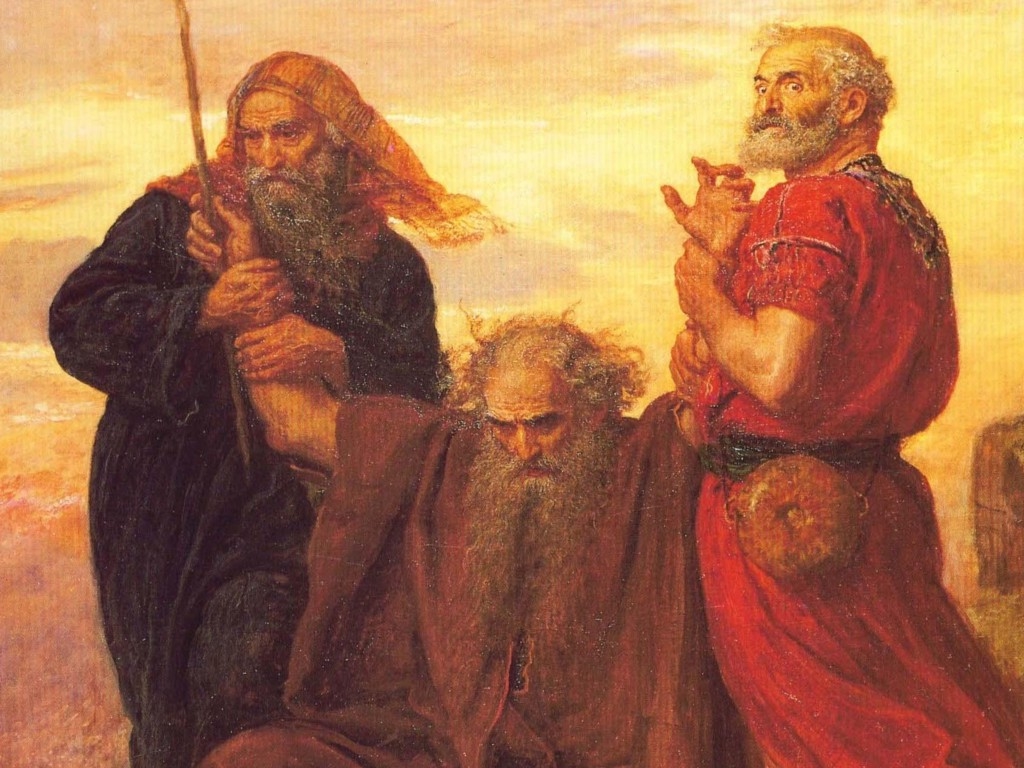
Aaron and Hur... and Benedict

"... As long as Moses kept his hands raised up, Israel had the better of the fight, but when he let his hands rest, Amalek had the better of the fight.  Moses' hands, however, grew tired , so they put a rock in place for him to sit on.  Meanwhile Aaron and Hur supported his hands, one on one side and one on the other, so that the hands remained steady till sunset.  And Joshua mowed down Amalek and his people with the edge of the sword."  Exodus 17:11-13
   The image presented in this morning's Office of Readings, I think, is a timeless icon for ministry in the Church, and a wonderful image to consider as we look into the upcoming Sede Vacante of the Holy See.  As a priest and pastor, it is the people who stand with you, holding your arms up in those moments of fatigue, doubt, and trial that help you remember not only the limitations of your own strength, but the providence of God to provide.  All the more, how our bishops and our pope needs people standing with him, holding his arms to provide the strength to bear their offices well.
   Pope Benedict has rececived this spiritual support from the entire Church, and he has needed it.  Every time we celebrate Mass, he is mentioned during the Eucharistic Prayer... both as a reminder to pray for him, but even more importantly as a reminder of the unity of the Church we express in and with him before Christ.  Now as he steps back from the papal office, he sees his role as one standing, holidng up the arms of his successor... I presume that popes do intercede for their successors before the throne of God as they go on to their eternal reward, but Benedict's work is being done with not only incredible humility (recognizing he doesn't have the physical ability to hold the office any more), but with increidble spiritual intimacy... anyone who believes that, in this world, they have the ability to do the spiritual labor of supporting the Church and the one who will be the new pope, while still in this clumsy, limited human condition we all experience, has to be a true prayer warrior.  As I said in a previous post, for Benedict to accept this role for the Church places a spotlight on the thousands of religious and faithful everywhere who spend their days hidden in deep, profound, effective prayer for the holiness and deliverance of the Church.

Tuesday, February 26, 2013

Adopt a Cardinal!

I just saw this over at Curt Jester, and thought... wow!  This is exactly what the Church needs to be doing right now: less chatter, more prayer.


And so, I encourage my readers... all dozen or so of you... to go out and do this.  Adopt a cardinal for some serious fasting and prayer support in the coming weeks, not only as they elect a pope, but because cardinals probably need all the spiritual support they can get anyway.

Here's my cardinal:

Picture of
Name:José da Cruz Policarpo
Country:Portugal
Day of birth:1936-2-26
Cardinal since:2001-2-21
Function:Patriarch of Lisbon, Portugal

It turns out, I was in Rome with a bunch of seminarian buddies when he was elevated to the Sacred College back in 2001.  And get this... today's his birthday... what do you know?!

Your eminence, prayers are on their way.  May the Spirit reveal to you and your brothers our next Holy Father.
-- Fr. Tom Donovan

Pope Benedict XVI on the "True Council" and the Media

   Just over a week ago, the pope gave a final talk to the priests and seminarians of the Diocese of Rome, where he gave what many are calling his "final master class".  As a paretus of the Council, a bishop, cardinal, and pope, he has a perspective on the Church over the last fifty years which has a lot to tell us about how we have managed to enter into conversation with the "modern world", where we still need work, and where the "modern world" has drawn a line in the sand, that we are not supposed to not cross, except at our peril.
   As I have been recently reflecting on the role of the media in our contemporary (notice, I don't say 'modern',) society, there's a lot of truth here.  The council and the Church at large is in search of the truth (fides quarens intellectum), plodding and erring as it does, but through the sure guidance of the Holy Spirit in every age, no less our own.  The pope understands the "council of the media" to have a much different agenda and end, not the City of God, but the City of Man... the hermeneutic of politics rather than the hermeneutic of faith.
   Benedict offers a very instructive contrast to make his point: the teaching of the "true" Council vs. the teaching of the media with regards to his most beloved subject: the liturgy.  My highlights below are in bold:
I would now like to add yet a third point: there was the Council of the Fathers - the true Council - but there was also the Council of the media. It was almost a Council in and of itself, and the world perceived the Council through them, through the media. So the immediately efficiently Council that got thorough to the people, was that of the media, not that of the Fathers. And while the Council of the Fathers evolved within the faith, it was a Council of the faith that sought the intellectus, that sought to understand and try to understand the signs of God at that moment, that tried to meet the challenge of God in this time to find the words for today and tomorrow. So while the whole council - as I said - moved within the faith, as fides quaerens intellectum, the Council of journalists did not, naturally, take place within the world of faith but within the categories of the media of today, that is outside of the faith, with different hermeneutics. It was a hermeneutic of politics. The media saw the Council as a political struggle, a struggle for power between different currents within the Church. It was obvious that the media would take the side of whatever faction best suited their world. There were those who sought a decentralization of the Church, power for the bishops and then, through the Word for the "people of God", the power of the people, the laity. There was this triple issue: the power of the Pope, then transferred to the power of the bishops and then the power of all ... popular sovereignty. Naturally they saw this as the part to be approved, to promulgate, to help. This was the case for the liturgy: there was no interest in the liturgy as an act of faith, but as a something to be made understandable, similar to a community activity, something profane. And we know that there was a trend, which was also historically based, that said: "Sacredness is a pagan thing, possibly even from the Old Testament. In the New Testament the only important thing is that Christ died outside: that is, outside the gates, that is, in the secular world". Sacredness ended up as profanity even in worship: worship is not worship but an act that brings people together, communal participation and thus participation as activity. And these translations, trivializing the idea of the Council, were virulent in the practice of implementing the liturgical reform, born in a vision of the Council outside of its own key vision of faith. And it was so, also in the matter of Scripture: Scripture is a book, historical, to treat historically and nothing else, and so on.
And we know that this Council of the media was accessible to all. So, dominant, more efficient, this Council created many calamities, so many problems, so much misery, in reality: seminaries closed, convents closed, liturgy trivialized ... and the true Council has struggled to materialize, to be realized: the virtual Council was stronger than the real Council. But the real strength of the Council was present and slowly it has emerged and is becoming the real power which is also true reform, true renewal of the Church. It seems to me that 50 years after the Council, we see how this Virtual Council is breaking down, getting lost and the true Council is emerging with all its spiritual strength. And it is our task, in this Year of Faith, starting from this Year of Faith, to work so that the true Council with the power of the Holy Spirit is realized and Church is really renewed. We hope that the Lord will help us. I, retired in prayer, will always be with you, and together we will move ahead with the Lord in certainty. The Lord is victorious. Thank you. 
   The instructive point here is that we are all conditioned by the lenses we use to see the world, but those lenses themselves are not truth. Truth is perceived and identified and loved by people of faith who rightly interpret the messages and the signs and the challenges of the times. Those who can only see the Church as a mere social structure, where power is distributed and exercised, where order and coercion is maintained, where human beings control their own identity and destiny... they will always be disappointed as they see the Church in her authenticity and in her reality stand up and breathe fresh air upon the world through its teaching and its understanding of the human person in relationship to God. One only has to look at the angst spent against the Church in the recent debates against same-sex 'marriage' and the decades-old battle against abortion. These debates tend not to be a battle from enlightened ideas from "the world", so much an array of ideologies calling into question the legitimacy of the Church to even enter into the conversation. Read the comments on your local newspaper's blog whenever an article about the Church appears if you want to understand what I mean. This battle is personal, but we cannot back down from that battle.
   To apply a political lens to the Church, and to see the Church exclusively as a social reality results so readily in the misery, not only of closed seminaries and convents and weak liturgy as the pope points out, but may I add, the misery of poor Mass attendance (both in numbers and in fervor of those who are there), failing Catholic schools, a demoralized clergy, diminished human and financial resources, and a scattered (and scattering) laity. Benedict is getting at, most pressingly, the way a media hermeneutic has depleted the "imagination" of the faithful such that we don't even understand our own signs and symbols, prayers and practices... we have allowed ourselves to become unmoored in the muddy waters of contemporary, worldly concerns. I would dare say that reacquisition of this "spiritual imagination" is the great gift and the integrating force of the Council, in which Benedict finds and offers hope for the future.
   This is not to say that the political lens of the media is an invalid way to look at the Church in the contemporary world, but it cannot be the only way or even the main way if we are to be people of faith. Faith does not cover up the wounds and scars of past failures, but it can offer redemption to these wounds if allowed to permeate them. Faith is not an easy answer... it is, in reality, the hardest answer to underlying the question of the Church and its relationship to secular society. Faith engages all the reason the human person can generate, all the hope the human person can endure, and all the life and vitality the human person can offer. "Take up your cross and follow me" is not a game for wimps. It is not a bargain for those who think they can hold something back for themselves, just in case. It requires all that we are and all that we can offer.
   Without faith, there is no way that we can see the Church except in the most pathetic, dimmest light. I think Paul said something that pulls at least tangentially here: "If only for this life we have hoped in Christ, we are the most pitiable people of all." (1 Cor 15:19) As the machinery gears up for the conclave and the seasonal press coverage of the Church, remember the reference point of the media and the need for the gift of great faith to interpret the events correctly and fully. A week after the press circus leaves Vatican Square and the new pope gets on with the business of being the spiritual father of more than 1 billion Catholics, it will be the faith of the people that sustains him and the Church. The faith which will propel us to whatever the Spirit has in store for us next.

--Fr. Tom Donovan


Monday, February 25, 2013

Homily Thoughts - 2-Lent C

   I don't do much travelling, but last year at this time, I was in Germany in service to the Air Force.  On the Second Sunday of Lent, I had my one and only 'weekend off', which I used to travel to Paris which was only a couple hours away by the 300km/h bullet train.
   I had never been to Paris, although I had always hoped to get there at some point.  I took French back in high school, now twenty-five years prior, and I was pretty good at it.  I hadn't necessarily practiced my French much in the past years, but when I learned it, I was a young person, whose brain was still plastic enough to acquire not just a syntactical and analytical understanding of the language, but an idiomatic and 'natural' grasp... I was able to "think" in French back in the day... all I need to do as an older person is now have enough vocabulary to be functional in this new (old) environment.
  And so, I got a couple of 24 hour passes on the metro, a cheap hotel room by the Gard du Nord (the north train station), and Paris was mine until Sunday night at 9pm.
Notre Dame de Paris (photo by me)
  My most desired target was Notre Dame de Paris, in the spiritual center of town, on the Isle de la Cite, in the midst of the Seine.  After dumping my bags at the hotel (which was a story in itself... it was in a rather creepy neighborhood), and a couple minutes of interpreting the metro maps, I jumped on a train and eventually came out of the ground and saw the ancient cathedral.  Coming upon the Cathedral for the first time is sort of like the first time going to Wrigley Field or St. Peter's Square or any other famous place only previously seen on TV or in pictures.  The weight of the history and mystery of the place kind of hits you, and you realize that of all the places in the world you could be, you are there... at this iconic place at this iconic time.  So on Saturday, I simply went inside and milled around as all the tourists do.  I was able to catch the daily Mass, which I believe was at noon.  It was in French, of course, but it was the Mass.  You could hear people responding to the prayers in French and English and Latin and some other languages, and then there was also the constant din of the tourists who were circling the arcades and transepts around the main body of the church.  After Mass, I considered how Thomas Aquinas probably said Mass at this altar... or at least in this or that alcove.  I considered the horror of the Enthronement of the Goddess of Reason upon the altar during the Revolution.  I took some time to offer the office (from my cell phone) before the Blessed Sacrament one of the chapels in the back of the Church.
  That night, there was to be a Lenten concert of sacred music, which I came back for, and then I headed to the Tower for dinner on the Seine before calling it a night.  Mass the next day was at 11-ish, I think, and it was the "International Mass", which was celebrated by an African priest-student at one of the universities.  He celebrated in French... and I had practiced my French responses very carefully and was ready to offer any of the concelebrant's parts of any of the the Eucharistic Prayers in the local tongue.  As the "international" Mass, though, the sacristan insisted that I take one of the post-institutional prayers in English to edify the visitors (?), and provided me with a photocopied page of the old, familiar sacramentary (the old edition!) of EP-III.  So, the brute-tongue of English was heard resounding through the great French Cathedral with my unmistakable Central Illinois accent on that memorable morn.


Pilgrim's "Passport" for the pilgrimage
of St. James (source: Wiki)
   Spiritual travels have long been a feature of Christian devotion... pilgrimages we call them.  One would try to go on pilgrimage to the Holy Land if they had the means and the spiritual devotion.  Many go to Rome to see St. Peter's and the other early Christian sites.  Others travel to Lourdes or Fatima or Ars, still others to more local destinations...  some travel the roads from France to Santiago in Spain for the feast of St. James every July.  In Germany I saw the thousand-year-old Cathedrals at Mainz and Cologne.  In the States we have the Basilica Shrine in DC, the Cathedral of St. Louis, and other destinations as well.  When we travel to these destinations, we do so out of both spiritual and tourist motives, looking to see something we haven't seen... to appreciate the faith of a time and place heretofore unknown... at its most basic, to encounter God in a new and special way during the efforts of our travels.  This is part of the incarnational aspect of our Christian faith... that God uses places and times and people and events for special purposes.  Life among these revealed signs of God's love is nothing less than a continual journey of discovery.
   And so, this second Sunday in Lent, Jesus leads us on a journey-- a pilgrimage of faith, to experience something new and different.  He presents himself in all of his glory to Peter, James, and John... and the Gospel narrative invites us along to see and experience the event as well.  Pope St. Leo the Great assures us in the Office of Readings that this prefigurement of the Lord's glory is intended to be a consolation against the backdrop of the crucifixion we are about to 'witness' as we continue more deeply into the journey of Lent.  Indeed, it is a waypoint to help us remember what our fasting and prayer and almsgiving is all about--not an end to itself, but like the cross, a seed planted in anticipation of a future glory.
   Now Peter, reliably, doesn't get it.  Seeing the glory of God revealed in Jesus, he proclaims to the Lord that he intends to memorialize that place.  He proposes to put up three huts... one for you (Jesus), one for Moses, and one for Elijah.  Maybe this could be a place where an enterprising apostle could set up a fourth booth to charge admission?  Instead, a cloud envelops him, showing us his spiritual blindness, and calling him and us back into Jesus' intended message.
   While pilgrimage is an important icon for our spiritual struggles, and while churches and destinations are important symbols in our spiritual lives, unlike so many other expressions of religious faith, Christianity is ultimately not centered on places or things or even ideas.  Christianity is focused on the person of Christ... "this is my beloved Son, listen to him!"  This is not to deny that incarnational aspect of our faith that enjoys a good pilgrimage, but it recognizes that this world, when raised beyond what we can merely see, reveals the glory of God which calls us beyond time and place and space into relationship with him alone.
   And so, what we commemorate in the Transfiguration, what we recall each Sunday as we gather at the altar is not just one or another miraculous event or memorable episode in the life and history of Christ, but the intimacy and immediacy of his glory when we meet him in person.  On that altar, we encounter no one less than the God of all creation, who wishes to draw us into his life and glory.  This is who we meet, whether at the Pope's altar in Rome, in our parish church, at Notre Dame Cathedral, in a foreign mission, at a prison or in a hospital or on the hood of a Jeep in some war zone or in a funeral parlor.  Christ is present.  It is not the places that are holy, but his divine presence that metamorphoses us as we stand in a particular time and space made holy by that presence.  Even when God's glory is not plainly visible, perhaps being hidden away under sacramental signs that our senses fail to recognize, his presence still beckons unto the glory of the world to come.
   For my own life and ministry, this realization is no less true.  I celebrated Mass this Second Sunday of Lent today in a quiet, rural chapel before a group of religious sisters, rather than in the glory of that great French cathedral or in my own parish church.  His glory might have seemed somewhat more hidden today, but his presence was unmistakeably there.  I am drawn to thinking of others who find themselves in new or difficult situations this year as they hear this Gospel... a particular family caring for its father in a hospital in St. Louis this weekend after a health crisis which has changed their lives forever.  May they recall how the Lord has loved them and protected them in the past and recognize Christ's enduring presence now.  I am also thinking of a brother priest whose mother died today.  May he and his family remember their mother with love and thanksgiving before God, embracing Christ's continued and newly-revealed glory with them today.
   We all are in different places and different times this Second Sunday of Lent, but it is no less sacred, no less precious in the eyes of our suffering, glorified Lord, who lies just beyond our sight, accompanying us on our earthly pilgrimages.  The sufferings of this world are no comparison to the glory that awaits.  The Transfiguration reminds us of not only the glory of our Lord, but also of his presence and immediacy in the humble and everyday as continue up to Jerusalem, taking up our crosses to follow him.

Friday, February 22, 2013

Twelfth Station: St. Alphonse Ligouri (1787)

The Twelfth Station:
Jesus Dies Upon the Cross

We adore You, O Christ, and we praise You.
Because, by Your holy cross, You have redeemed the world.

Consider how Your Jesus, after three hours of agony on the cross, is finally overwhelmed with suffering and, abandoning Himself to the weight of His body, bows His head and dies.

My dying Jesus, I devoutly kiss the cross on which You would die for love of me.  I deserve, because of my sins, to die a terrible death;  but Your death is my hope.  By the merits of Your death,  give me the grace to die embracing Your feet and burning with love of You.  I yield my soul into Your hands.  I love You with my whole heart.  I am sorry that I have offended You.  Never let me offend You again.  Grant that I may love You always; and then do with me as You will.

Bulletin Article 2L-C

   Every second Sunday in Lent, we hear an account of the Transfiguration of the Lord. In this event, Jesus revealed his glorified body to Peter, James, and John. The disciples’ response seems rather puzzling, though: “Let us build three tents: one for you, one for Moses, and one for Elijah.” It seems disciples were seeking a moment to rest in this amazing encounter and have a place—a destination—where they and others could come to see the Lord and these revered prophets. In a way, this was a first step in ’capturing’ or ‘localizing’ the religious experience to a specific place or a specific time so that they could come back and draw strength from it later. In a way, the disciples were asking Jesus if they could build the first Christian church on that mountaintop site.
   Our church buildings and structures are the places where heaven and earth unite.  A church building is the nexus point of for the Church militant, the Church suffering, and the Church victorious, where all gather, singing the unending angelic hymn of Holy, Holy, Holy is God Almighty. (see Rev. 4:8) We hold special regard for these places where the Christian community gathers by anointing its walls, consecrating its altars, and reserving its spaces for the exclusive use of sacred rites. In many old churches, one can vaguely sense the decades of burnt incense and beeswax candles lingering in the air and on its walls.  One can see the effects of generations of feet which have tread the steps or the hands which have opened the doors or the knees that have knelt on its kneelers.  There is something special about our church buildings, but they do more than give shelter or simply mark the location of events in a family’s or community’s history.  They are the places where we encounter the Glorified Body of Christ in the Eucharist and the other sacraments. Here, too, we encounter the reality of the Christian people gathered as the Mystical Body of Christ.
   The disciples did not build a church on that site the day that Jesus was transfigured before them. In fact, all the Gospel accounts tell us that they were silenced until after the Resurrection. Is there something we might learn from this? I wonder if the disciples still had more to learn about the resurrection before they could be ready to commemorate the sights and sounds of that amazing day with a Church or pilgrimage site? I wonder if they were halted because they were not yet in full possession of the mystery which Jesus wanted them to have a glimpse of? I wonder if Jesus thought they were getting ahead of themselves in trying to commemorate in buildings an event that had not yet fully marked their hearts and minds and souls?
   Whatever the reason, the Transfiguration reminds us that our faith is more than history, buildings, institutions, politics, customs, locations, cultic practices, people, saints, visions, hopes, and dreams—as good as these things may be. The Transfiguration reminds us of the absolute centrality of Jesus Christ—the Risen Lord whom we encounter in the Eucharist—as the center and the summit of our faith.


Friday, February 15, 2013

Twelfth Station: Cardinal Ratzinger (2005)


Via Crucis, Scuola Veneta - Sec. XVIII
Cattedrale - Padova
TWELFTH STATION
Jesus dies on the Cross
V/. Adoramus te, Christe, et benedicimus tibi.
R/. Quia per sanctam crucem tuam redemisti mundum.

From the Gospel according to John 19:19-20

Pilate also wrote a title and put it on the Cross; it read, “Jesus of Nazareth, the King of the Jews”. Many of the Jews read this title, for the place where Jesus was crucified was near the city; and it was written in Hebrew, in Latin, and in Greek.

From the Gospel according to Matthew 27:45-50,54

Now from the sixth hour there was darkness over all the land until the ninth hour. And about the ninth hour Jesus cried with a loud voice, “Eli, Eli, lama sabachthani?” That is, “My God, my God, why have you forsaken me?” And some of the bystanders hearing it said, “This man is calling Elijah”. And one of them at once ran and took a sponge, filled it with vinegar, and put it on a reed, and gave it to him to drink. But the others said, “Wait, let us see whether Elijah will come to save him”. And Jesus cried again with a loud voice and yielded up his spirit”. When the centurion and those who were with him, keeping watch over Jesus, saw the earthquake and what took place, they were filled with awe, and said, “Truly this was the Son of God!”
 
MEDITATION:  In Greek and Latin, the two international languages of the time, and in Hebrew, the language of the Chosen People, a sign stood above the Cross of Jesus, indicating who he was: the King of the Jews, the promised Son of David. Pilate, the unjust judge, became a prophet despite himself. The kingship of Jesus was proclaimed before all the world. Jesus himself had not accepted the title “Messiah”, because it would have suggested a mistaken, human idea of power and deliverance. Yet now the title can remain publicly displayed above the Crucified Christ. He is indeed the king of the world. Now he is truly “lifted up”. In sinking to the depths he rose to the heights. Now he has radically fulfilled the commandment of love, he has completed the offering of himself, and in this way he is now the revelation of the true God, the God who is love. Now we know who God is. Now we know what true kingship is. Jesus prays Psalm 22, which begins with the words: “My God, my God, why have you forsaken me?” (Ps 22:2). He takes to himself the whole suffering people of Israel, all of suffering humanity, the drama of God’s darkness, and he makes God present in the very place where he seems definitively vanquished and absent. The Cross of Jesus is a cosmic event. The world is darkened, when the Son of God is given up to death. The earth trembles. And on the Cross, the Church of the Gentiles is born. The Roman centurion understands this, and acknowledges Jesus as the Son of God. From the Cross he triumphs – ever anew.

PRAYER:  Lord Jesus Christ, at the hour of your death the sun was darkened. Ever anew you are being nailed to the Cross. At this present hour of history we are living in God’s darkness. Through your great sufferings and the wickedness of men, the face of God, your face, seems obscured, unrecognizable. And yet, on the Cross, you have revealed yourself. Precisely by being the one who suffers and loves, you are exalted. From the Cross on high you have triumphed. Help us to recognize your face at this hour of darkness and tribulation. Help us to believe in you and to follow you in our hour of darkness and need. Show yourself once more to the world at this hour. Reveal to us your salvation.